AI for restaurants pays first on the menu, not on the phone. Toast usage data from more than 125,000 US restaurant locations shows menu work is 72 percent of all AI action requests, with updating item stock at 31 percent. Start with a 60-day menu spreadsheet, add ordering forecasts, then let AI draft your review replies.
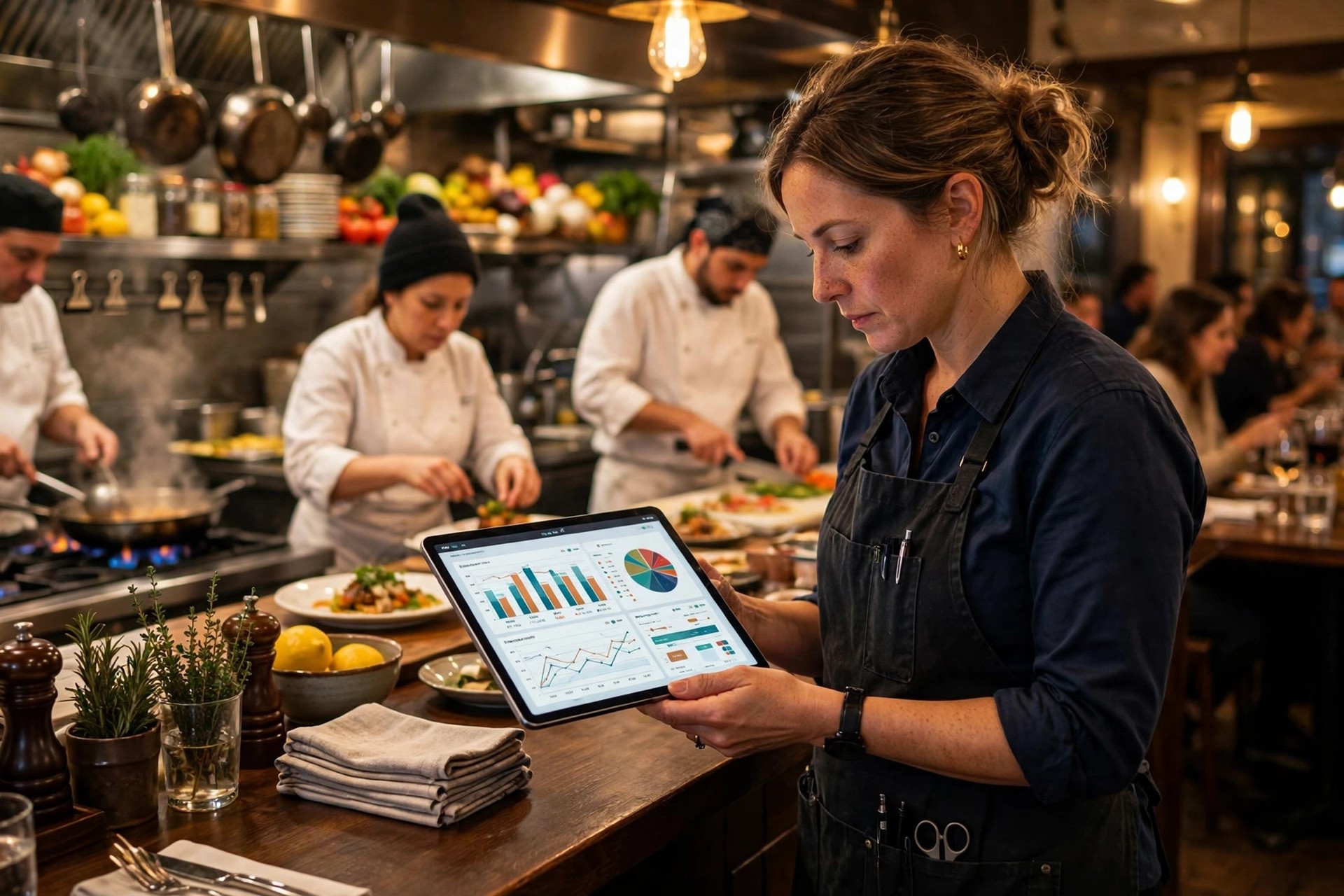
What restaurants actually ask AI: Toast IQ usage in Q2 2026
Toast published usage data for Toast IQ from more than 125,000 US restaurant locations in the second quarter of 2026, and it tells you where operators really spend their AI time. Sales and revenue prompts were 30 percent of threads, and menu management was 8 percent. More than half of all prompts, 53 percent, happened during the lunch or dinner rush, when the kitchen is busiest and the manager has the least time to think.
When operators asked for an action rather than an answer, menu work was 72 percent of all action requests. Updating item stock, or 86-ing a dish, was 31 percent, and adding a menu item was 7 percent. About 12 percent of menu and inventory queries ended in a request for a change. Operators also use it for weekend and event sales forecasts, to set staffing and ordering before the rush starts.
Read that data with care: this is Toast's own product usage, not industry-wide ROI. It measures what users asked the AI to do, not whether the action was completed or whether any money was saved. A prompt is not a profit.
Menu engineering: the 60-day spreadsheet that pays first
Menu engineering is the highest-value AI job in a restaurant, and it starts with a spreadsheet, not a purchase. Pull 60 days of item-level sales from your POS, add the food-cost percentage and the contribution margin for each dish, and sort the menu into four groups: Stars, Puzzles, Plowhorses, and Dogs.
The AI part is the sorting and the flagging. Toast IQ flags low-margin and low-velocity items for you, and Square's Managerbot can surface the same numbers if you ask it plainly. But the decision stays with you. Low sales alone does not mean you remove a dish. A Dog might bring in the regulars who order the Stars.
Run the sort once a month and act on one change at a time. Raise the price on a Puzzle by a small step and watch its sales for two weeks. Move a Star to the top of the menu. Rework a Plowhorse with a cheaper cut or a smaller portion. Remove a Dog only after you have checked its margin, its prep time, its season, and what else on the menu it supports. One change a month, measured, beats a whole menu rewrite done on a guess.
Ordering and prep forecasts: covers by daypart, without over-ordering
Forecasting starts with your own history. Take covers by daypart from your POS, meaning lunch, dinner, and late night as separate numbers, then add bookings, the weather forecast, and local events. AI can weigh those signals faster than a manager with a notebook, but the manager still approves the order.
The loop is what makes it work. Forecast the covers, place the order, then compare the forecast with what actually sold, and write down why it was wrong. Over-ordering wastes food and money. Under-ordering means 86-ing dishes during service, which is the worst time to run out. Record the reason for the miss, not just the number, because the reason is what the next forecast learns from.
Labour: predictive staffing without cutting the wrong shift
Predictive staffing uses the same forecast to set the rota. A busy Saturday needs more hands on the floor and in the kitchen, and a slow Monday does not. The trap is cutting the wrong shift to save money. A short-staffed Friday costs more in lost sales and bad reviews than the wages you saved, and good staff leave when every shift feels like a panic.
Review replies: the draft-and-send rule
AI drafts about 80 percent of review replies in your voice, and that is the honest number to plan around. The other 20 percent still needs you, and the replies under 4 stars always need you. A human reads and sends every sub-4-star reply. Never auto-post a negative response, because an annoyed guest deserves a person, not a bot, and a wrong auto-reply can turn a small complaint into a public fight.
AI must not invent a resolution, promise compensation, or write as if it served the guest. If a reviewer says the food arrived cold, the draft may apologize and invite them back. It may not say you refunded them unless a person confirms that happened. Complaint resolution and allergen or dietary questions are the two uses diners rate least appropriate for AI, so keep those firmly in human hands.
Google Business Profile plus AI review drafting is free, which makes it the highest-return AI a small restaurant can run. Reply to every review, good and bad, within a day or two, and keep the voice the same across all of them.
UK numbers are not US numbers: the Toast survey warning
Be careful with the Toast survey figures you will see quoted elsewhere. Toast's UK research, from 400 managers and 500 diners in October 2026, says 30 percent of operators already use AI to personalise offers, 58 percent of managers using AI said it increased visits and spending. Those figures are UK, not US.
The US figure to use instead is the SevenRooms 2025 Trends Report, a vendor survey, which says 79 percent of restaurant operators now use AI in some form. There is no independent US ROI study behind either number, which is why this post says savings are unknown rather than inventing a figure.
The tools, priced: what your POS already includes vs what costs extra
Start with what you already pay for. Toast IQ is included with Toast POS, which lists the Starter Kit at $0 a month and Point of Sale at $69 a month. Toast IQ Grow has no published price, so ask for a quote. Square Managerbot is free in open beta, and Square for Restaurants runs at $0, $49, or $149 a month per location.
| Tool | Price | AI included |
|---|---|---|
| Toast POS | Starter Kit $0 a month; Point of Sale $69 a month | Toast IQ included; IQ Grow price not published |
| Square for Restaurants | $0, $49, or $149 a month per location | Managerbot free in open beta |
| OpenTable | Basic $149, Core $299, Pro $499 a month | AI review replies on Pro; plus $1.00 to $1.50 per network cover |
| Resy | Platform about $289, Platform 360 about $459 a month | No per-cover fee; prices reported, check before you buy |
| SevenRooms | No published price; reported $500 or more a month | Voice AI for bookings; setup reported $5,000 to $25,000 |
| Google Business Profile + AI drafting | Free | Review replies, the cheapest useful AI you can run |
OpenTable charges $149 a month for Basic plus $1.50 a network cover after 30 days, $299 for Core plus $1.00, and $499 for Pro plus $1.00, with AI review replies on Pro. Resy lists Platform at about $289 a month and Platform 360 at about $459, with no per-cover fee, but treat those as reported figures and check before you buy. SevenRooms has no published price at all, and the reported range is $500 or more a month, up to $700 to $1,000, with setup reported at $5,000 to $25,000 on an annual contract.
For the POS choice itself, read our Square vs Toast comparison for restaurants in 2027. For the wider AI picture, see AI tools for small restaurants, and for the automation plan around them, how to automate a small business with AI in 2026.
A one-location starter stack, free to $69 a month
For one location, the starter stack is simple. Use the AI inside the POS you already pay for, Toast IQ or Square Managerbot, and pay nothing extra. Add Google Business Profile with AI-drafted replies, which is free. Run the 60-day menu spreadsheet once a month. That stack costs $0 to $69 a month.
Add OpenTable or Resy only when reservations are your bottleneck, and add SevenRooms only when you have the cover volume to justify a quote-only tool with a reported $5,000-plus setup. Do not buy a $500-a-month platform to solve a problem your POS already solves for free.
What AI should never decide alone
Three things stay with a person. Prices, because a wrong price change reaches every customer at once. Allergens and dietary questions, because a wrong answer can hurt someone. Complaints, because a guest who feels unheard writes a review that lasts. AI can draft the words for all three and should not send any of them.
Keep a simple rule on the wall: AI suggests, a person decides. The forecast suggests the order, the manager places it. The draft suggests the reply, the owner sends it. The spreadsheet flags the dish, the chef decides its fate. That rule is what keeps AI useful instead of risky.
The bottom line on AI for restaurants
AI for restaurants works best where Toast's usage data says operators use it: the menu, the stock list, and the forecast. Run the 60-day menu spreadsheet, forecast covers by daypart, and let AI draft your replies while a person sends them. Start with the AI inside your POS, and treat savings as unknown until your own numbers prove otherwise. Sources: SevenRooms on restaurant AI tools and JusGrow on AI agents for restaurants, October 2026. Prices re-checked November 2026.